publications
publications by categories in reversed chronological order. generated by jekyll-scholar.
2025
- PhD Thesis
 Computational Design Through Differentiable Elastodynamic Simulation, Parametrized by Geometric Techniques, for Applications in Soft RoboticsArvi GjokaNew York University, 2025
@phdthesis{gjoka2025thesis, author = {Gjoka, Arvi}, title = {Computational Design Through Differentiable Elastodynamic Simulation, Parametrized by Geometric Techniques, for Applications in Soft Robotics}, school = {New York University}, year = {2025}, } - Computational Modeling and Design of Capacitive Stretch SensorsArvi Gjoka, Yongkang Sun, Roi Poranne, and 1 more authorACM Trans. Graph., Dec 2025
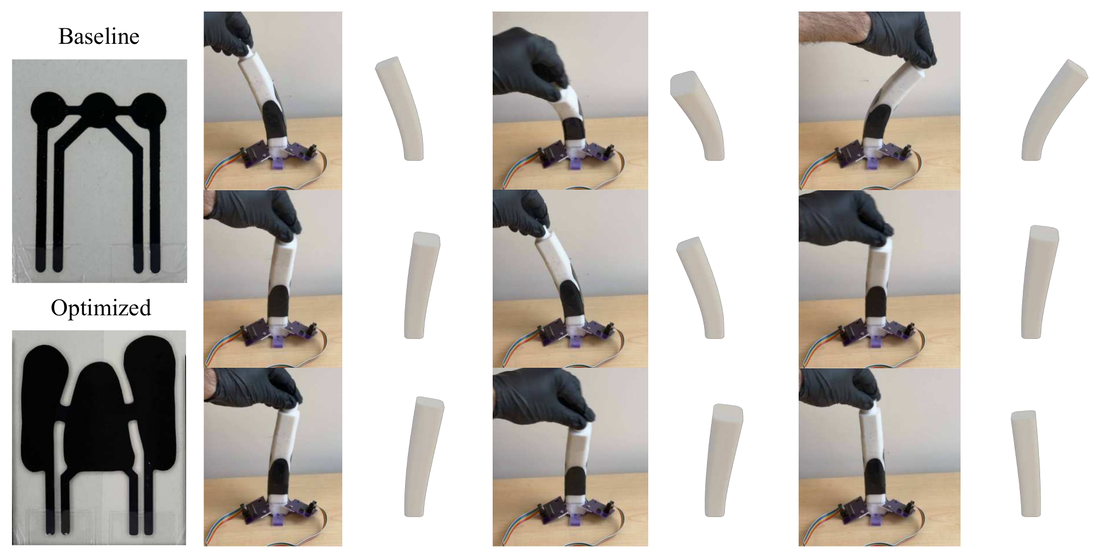
A stretch sensor is a device that attaches to objects and measures the amount by which they deform. These sensors have shown great promise as an alternative to vision-based motion-capture systems, and for robotic sensing. Currently, they are generally limited to linear designs, and require a somewhat challenging calibration process. Our goal is to enable inverse design of such sensors, and to largely eliminate the calibration process. To this end, we introduce an accurate, differentiable simulator for capacitive stretch sensors, that treats both the elasto- and electro-static parts of the system. Differentiability allows optimizing the geometry of the sensor in order to improve its design for specific applications. We demonstrate the accuracy of our simulator and the effectiveness of our sensor optimization process for various use cases, such as human interfaces and robotics.
@article{gjoka2025stretchsensors,
  author = {Gjoka, Arvi and Sun, Yongkang and Poranne, Roi and Panozzo, Daniele},
  title = {Computational Modeling and Design of Capacitive Stretch Sensors},
  journal = {ACM Trans. Graph.},
  year = {2025},
  month = dec,
  volume = {44},
  number = {6},
  articleno = {239},
  numpages = {15},
  publisher = {Association for Computing Machinery},
  address = {New York, NY, USA},
  doi = {10.1145/3763274},
  url = {https://doi.org/10.1145/3763274},
  keywords = {Deformable Sensing, Differentiable Simulation, Soft Robotics, Shape Optimization, Finite Element Method},
}
2024
- Soft Pneumatic Actuator Design using Differentiable SimulationArvi Gjoka, Espen Knoop, Moritz Bächer, and 2 more authorsIn Special Interest Group on Computer Graphics and Interactive Techniques Conference Conference Papers ’24, Denver, CO, USA, Jul 2024
We propose a computational design pipeline for pneumatically-actuated soft robots interacting with their environment through contact. We optimize the shape of the robot with a shape optimization approach, using a physically-accurate high-order finite element model for the forward simulation. Our approach enables fine-grained control over both deformation and contact forces by optimizing the shape of internal cavities, which we exploit to design pneumatically-actuated robots that can assume user-prescribed poses, or apply user-controlled forces. We demonstrate the efficacy of our method on two artistic and two functional examples.
@inproceedings{gjoka2024pneumatic, author = {Gjoka, Arvi and Knoop, Espen and B\"{a}cher, Moritz and Zorin, Denis and Panozzo, Daniele}, title = {Soft Pneumatic Actuator Design using Differentiable Simulation}, booktitle = {Special Interest Group on Computer Graphics and Interactive Techniques Conference Conference Papers '24}, series = {SIGGRAPH Conference Papers '24}, year = {2024}, month = jul, articleno = {106}, numpages = {11}, location = {Denver, CO, USA}, isbn = {9798400705250}, publisher = {Association for Computing Machinery}, address = {New York, NY, USA}, doi = {10.1145/3641519.3657467}, url = {https://doi.org/10.1145/3641519.3657467}, keywords = {Differentiable Simulation, Finite Element Method, Pneumatic Actuator, Shape Optimization, Soft Robotics}, } - Differentiable solver for time-dependent deformation problems with contactZizhou Huang, Davi Colli Tozoni, Arvi Gjoka, and 4 more authorsACM Trans. Graph., May 2024
We introduce a general differentiable solver for time-dependent deformation problems with contact and friction. Our approach uses a finite element discretization with a high-order time integrator coupled with the recently proposed incremental potential contact method for handling contact and friction forces to solve ODE- and PDE-constrained optimization problems on scenes with complex geometry. It supports static and dynamic problems and differentiation with respect to all physical parameters involved in the physical problem description, which include shape, material parameters, friction parameters, and initial conditions. Our analytically derived adjoint formulation is efficient, with a small overhead (typically less than 10% for nonlinear problems) over the forward simulation, and shares many similarities with the forward problem, allowing the reuse of large parts of existing forward simulator code. We implement our approach on top of the open-source PolyFEM library and demonstrate the applicability of our solver to shape design, initial condition optimization, and material estimation on both simulated results and physical validations.
@article{huang2024diffipc,
  author = {Huang, Zizhou and Tozoni, Davi Colli and Gjoka, Arvi and Ferguson, Zachary and Schneider, Teseo and Panozzo, Daniele and Zorin, Denis},
  title = {Differentiable solver for time-dependent deformation problems with contact},
  journal = {ACM Trans. Graph.},
  year = {2024},
  month = may,
  volume = {43},
  number = {3},
  articleno = {31},
  numpages = {30},
  issn = {0730-0301},
  publisher = {Association for Computing Machinery},
  address = {New York, NY, USA},
  doi = {10.1145/3657648},
  url = {https://doi.org/10.1145/3657648},
  keywords = {Differentiable simulation, finite element method, elastodynamics, frictional contact},
}


2021
- An Extensible Benchmark Suite for Learning to Simulate Physical SystemsKarl Otness, Arvi Gjoka, Joan Bruna, and 4 more authorsIn Thirty-fifth Conference on Neural Information Processing Systems Datasets and Benchmarks Track (Round 1), Dec 2021
Simulating physical systems is a core component of scientific computing, encompassing a wide range of physical domains and applications. Recently, there has been a surge in data-driven methods to complement traditional numerical simulations methods, motivated by the opportunity to reduce computational costs and/or learn new physical models leveraging access to large collections of data. However, the diversity of problem settings and applications has led to a plethora of approaches, each one evaluated on a different setup and with different evaluation metrics. We introduce a set of benchmark problems to take a step towards unified benchmarks and evaluation protocols. We propose four representative physical systems, as well as a collection of both widely used classical time integrators and representative data-driven methods (kernel-based, MLP, CNN, nearest neighbors). Our framework allows evaluating objectively and systematically the stability, accuracy, and computational efficiency of data-driven methods. Additionally, it is configurable to permit adjustments for accommodating other learning tasks and for establishing a foundation for future developments in machine learning for scientific computing.
@inproceedings{otness2021benchmark,
  author = {Otness, Karl and Gjoka, Arvi and Bruna, Joan and Panozzo, Daniele and Peherstorfer, Benjamin and Schneider, Teseo and Zorin, Denis},
  title = {An Extensible Benchmark Suite for Learning to Simulate Physical Systems},
  booktitle = {Thirty-fifth Conference on Neural Information Processing Systems Datasets and Benchmarks Track (Round 1)},
  year = {2021},
  month = dec,
  url = {https://openreview.net/forum?id=pY9MHwmrymR},
}

2020
- The iWildCam 2020 Competition DatasetSara Beery, Elijah Cole, and Arvi GjokaApr 2020
Camera traps enable the automatic collection of large quantities of image data. Biologists all over the world use camera traps to monitor animal populations. We have recently been making strides towards automatic species classification in camera trap images. However, as we try to expand the geographic scope of these models we are faced with an interesting question: how do we train models that perform well on new (unseen during training) camera trap locations? Can we leverage data from other modalities, such as citizen science data and remote sensing data? In order to tackle this problem, we have prepared a challenge where the training data and test data are from different cameras spread across the globe. For each camera, we provide a series of remote sensing imagery that is tied to the location of the camera. We also provide citizen science imagery from the set of species seen in our data. The challenge is to correctly classify species in the test camera traps.
@misc{beery2020iwildcam,
  author = {Beery, Sara and Cole, Elijah and Gjoka, Arvi},
  title = {The iWildCam 2020 Competition Dataset},
  howpublished = {CVPR Workshop on Fine-Grained Visual Categorization (FGVC7)},
  year = {2020},
  month = apr,
  archiveprefix = {arXiv},
  primaryclass = {cs.CV},
}

2019
- HistoryTracker: Minimizing Human Interactions in Baseball Game AnnotationJorge Piazentin Ono, Arvi Gjoka, Justin Salamon, and 2 more authorsIn Proceedings of the 2019 CHI Conference on Human Factors in Computing Systems, Glasgow, Scotland, UK, May 2019
The sport data tracking systems available today are based on specialized hardware (high-definition cameras, speed radars, RFID) to detect and track targets on the field. While effective, implementing and maintaining these systems pose a number of challenges, including high cost and need for close human monitoring. On the other hand, the sports analytics community has been exploring human computation and crowdsourcing in order to produce tracking data that is trustworthy, cheaper and more accessible. However, state-of-the-art methods require a large number of users to perform the annotation, or put too much burden into a single user. We propose HistoryTracker, a methodology that facilitates the creation of tracking data for baseball games by warm-starting the annotation process using a vast collection of historical data. We show that HistoryTracker helps users to produce tracking data in a fast and reliable way.
@inproceedings{ono2019historytracker,
  author = {Piazentin Ono, Jorge and Gjoka, Arvi and Salamon, Justin and Dietrich, Carlos and Silva, Claudio T.},
  title = {HistoryTracker: Minimizing Human Interactions in Baseball Game Annotation},
  booktitle = {Proceedings of the 2019 CHI Conference on Human Factors in Computing Systems},
  series = {CHI '19},
  year = {2019},
  month = may,
  pages = {1--12},
  numpages = {12},
  location = {Glasgow, Scotland, UK},
  isbn = {9781450359702},
  publisher = {Association for Computing Machinery},
  address = {New York, NY, USA},
  doi = {10.1145/3290605.3300293},
  url = {https://doi.org/10.1145/3290605.3300293},
  keywords = {sports tracking, sports analytics, hand annotation, baseball},
}
